“Summer Madness”という言葉から、多くの人が思い浮かべるのは、陽光、開放感、夏のドライブ、あるいは夜風に包まれた穏やかな時間だろう。
しかし、Yak-Town Boys Clubの「Summer Madness」が描く夏は、そのような爽快な季節ではない。
ここで鳴っているのは、暑さによって街の緊張が高まり、対立、報復、ドラッグ、銃撃、死が連鎖していく“危険な季節”としての夏である。
Kool & the Gangの同名曲「Summer Madness」が持つ幻想的で涼やかなムードを土台にしながら、その上に置かれるのは、低く沈んだ声、具体的な暴力描写、仲間への追悼、そして地元を背負う強烈なギャングスタ・アイデンティティだ。
約6分40秒という長尺の中で、複数のラッパーがほとんど途切れることなく言葉を重ねていく。
曲名は同じでも、ここにある“Summer Madness”は避暑地の幻想ではない。
ミシガン州ポンティアックの路上で、夏の熱気が狂気へと変わる瞬間を記録した、極めてローカルで生々しいギャングスタラップである。
アーティスト紹介
Yak-Town Boys Clubは、ミシガン州ポンティアックを拠点として活動していたギャングスタラップ・グループである。
資料によって表記は「Yak-Town Boys Club」と「Yacktown Boys Club」の両方が見られるが、一般的には前者の名称で知られている。
“Yak-Town”はPontiacを指すローカルな呼称であり、グループ名そのものが地元への帰属意識を示している。
公開資料では、中心メンバーはDraystoneとCoop Da Real、旧名Coupeとされている。また、グループには当初もう一人のメンバーがいた可能性も示されているが、詳細は明らかになっていない。
Yak-Town Boys Clubは1991年にカセット作品『Shit Niggaz Don’t Know!』を発表し、その後しばらく活動の間隔を空け、1996年に『I Need A Witness』をリリースしたとされる。活動時期はおおむね1991年から1996年で、Def Ro RecordsおよびMapless Recordsとの関連が記録されている。
のちにCoop Da Realはソロ活動を展開し、Money Gettin Boysという別グループの立ち上げにも関わったとされている。一方、Draystoneの1996年以降の詳しい活動については、公開情報が限られている。
全国規模の知名度を獲得したグループではないものの、Yak-Town Boys Clubは、デトロイトとは異なるポンティアック独自の初期ギャングスタラップを知るうえで重要な存在である。
作品背景
「Summer Madness」は、1991年に発表されたカセット作品『Shit Niggaz Don’t Know!』のB面に収録された楽曲である。
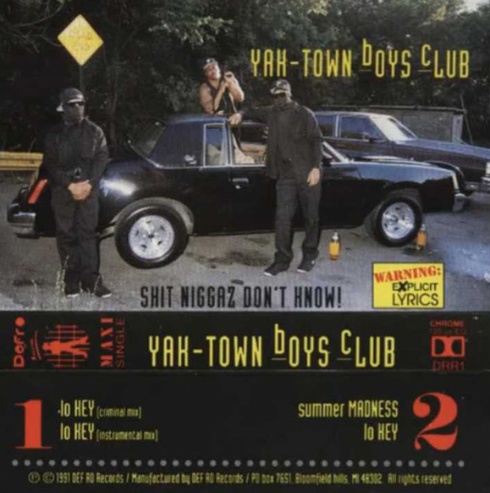
確認できるトラック構成は以下の通り。
A面には「Lo Key(Criminal Mix)」と「Lo Key(Instrumental Mix)」、B面には「Summer Madness」と「Lo Key」が収録されていた。
つまり本作は、1990年代半ばに確立されていくミッドウェスト・ギャングスタラップよりも前、1991年という早い時期に制作された作品である。
同時期のアメリカでは、西海岸のギャングスタラップが全国的な注目を集め始めていた一方、各地方都市でも、地元の生活環境やストリート事情を反映した自主制作ラップが作られていた。
「Summer Madness」もまた、そのようなローカル作品の一つだ。
洗練されたメジャー作品というより、限られた機材と地元のネットワークを使い、自分たちの街で起きていることをそのまま録音物へ落とし込んだような生々しさを持っている。
音源を実測すると、曲の長さは約6分39.9秒。
テンポは約92BPM前後で、当時のギャングスタラップとしては中速に位置する。
速さで緊張感を演出するのではなく、一定のテンポを保ちながら、重い言葉を一つずつ積み重ねていく構成だ。
第一印象
冒頭でまず耳に入るのは、静かに揺らめくシンセサイザーと、丸く沈んだベースである。
タイトルだけを見れば、穏やかなサマー・チューンを想像しても不思議ではない。
実際、トラックの表面には、夕暮れ、熱を残した夜の空気、ゆっくり流れる車窓の風景を思わせる浮遊感がある。
しかし、ラップが始まった瞬間に、その印象は反転する。
イントロでは、ラッパーが楽曲を始める前に二つの献辞を述べる。
一つ目は、“summer madness”に巻き込まれた仲間Sugar Bangへ向けられたものだ。本人は肉体的には共にいないが、精神はここにあるという趣旨の言葉が語られる。
二つ目は、現実のストリートで生きるギャングスタやOGたちへの献辞である。
この導入によって、曲が単なるフィクションや娯楽的なギャングスタ描写ではなく、仲間の死、地元の抗争、現実の喪失を背景に持つことが示される。
穏やかなトラックと、極端に暴力的な言葉との落差が強烈だ。
聴き心地だけなら滑らかである。
だが、描かれている世界は少しも穏やかではない。
この二重性こそが、「Summer Madness」の最も印象的な部分である。
サウンド分析
ドラム
テンポは音源解析上、約92BPM前後。
ドラムは派手に跳ねるタイプではなく、一定の間隔で淡々と進む。
キックは低く丸い。
輪郭を鋭く立てるというより、ベースと重なりながら楽曲の底を押し続ける役割を担っている。
スネアは比較的乾いているものの、現代のヒップホップのように前面へ突出してはいない。やや奥まった位置から鳴り、曲全体に古いカセット作品らしい距離感を与えている。
ハイハットや細かなパーカッションも控えめだ。
リズムを細分化して疾走感を生み出すのではなく、ラッパーが長いヴァースを展開できる広い空間を残している。
そのため、ビート自体は反復性が高い。
大きな展開やドラムブレイクで聴かせる曲ではなく、一定のリズムを維持することで、ラップの物語へ意識を集中させる設計である。
また、スウィング感は強すぎず、全体として比較的まっすぐなグルーヴを持つ。
しかし、ラップがビートの後方へわずかにもたれるため、機械的な硬さよりも、重く引きずるような感覚が生まれている。
ベース
ベースは本作の重要な要素の一つである。
極端に低いサブベースではなく、中低域を中心に丸く響くタイプだ。
キックとベースが明確に分離されているというより、互いの音域が重なり合い、一つの厚い土台を形成している。
ベースラインそのものは複雑ではない。
同じフレーズを繰り返しながら、楽曲全体に不穏な安定感を与えている。
ここでの安定感とは、安心感ではない。
むしろ、逃げ場のない状況が延々と続くような感覚である。
派手なベースの動きがないからこそ、ラッパーが語る銃撃や報復の描写が、日常の延長として淡々と響く。
暴力が特別な事件ではなく、街の通常運転になっている。
その感覚を、動きの少ないベースが下から支えている。
シンセ・メロディ
上物の中心には、Kool & the Gang「Summer Madness」に由来する幻想的な音像がある。
Yak-Town Boys Club版がKool & the Gangの1974年曲「Summer Madness」をサンプリングしていることは、WhoSampledにも記録されている。
原曲の象徴的なシンセサイザーが持つ、暑さで空気が揺らめくような質感を残しながら、ラップ用のループとして再構成している。
柔らかなコード、宙に浮くような高音、滑らかな鍵盤の響きが、楽曲全体を包んでいる。
ただし、サンプリングされたフレーズは明るい夏を直接表現しているわけではない。
むしろ、夜の街灯、熱気の残るアスファルト、遠くから聞こえるサイレンのような、少し現実離れした景色を生み出している。
原曲が持つ“夏の幻想”を、そのまま祝祭へ変換するのではなく、“熱によって理性が溶けていく街”の背景として使用している点が巧みだ。
シンセの音は長く伸び、輪郭も柔らかい。
対して、ラップの内容は極めて直接的で攻撃的である。
その対照によって、曲には夢と悪夢が同時に存在する。
ミックス・グルーヴ
ミックスは現代的な基準で見ると、中域に音が集中している。
低音は鳴っているが、現在のマスタリングのように深いサブベースが強調されているわけではない。
高域も派手に開いておらず、全体に少しくすんだ色調がある。
ボーカルは比較的前に配置されているものの、完全に分離されてはいない。
ラップ、サンプル、ドラムが同じ空間に押し込まれ、一体となって鳴っている。
この粗さは、単なる音質上の弱点ではない。
むしろ、カセット時代の地方録音らしい閉塞感を強めている。
曲全体の音量変化は大きくなく、約6分40秒にわたってほぼ同じ温度が保たれる。
そのため、一般的なポップスのような明確な盛り上がりは少ない。
しかし、この平坦さが、終わりの見えない夏の夜のような感覚を生み出している。
リズムは約92BPMでゆったりしているが、完全にレイドバックしたリラックス感はない。
穏やかなビートの裏側に緊張が張り付き、いつ何かが起きてもおかしくない状態が続いている。
ラップ/ボーカル分析
本作は、複数のラッパーが順番に長いヴァースを担当するマイクリレー形式で進む。
フックを挟みながら、各MCがそれぞれ異なる角度から“summer madness”を描いていく。
ラップの声質は全体的に低く、硬い。
感情を大げさに爆発させるというより、落ち着いた声で危険な内容を語るスタイルである。
この抑制されたデリバリーが、歌詞の恐ろしさを増している。
怒鳴り声で威嚇するのではなく、すでに暴力に慣れてしまった人物が、日常の出来事を説明するように銃撃や殺人を語る。
その温度の低さがリアルだ。
フロウは、ビートへ細かく言葉を詰め込むタイプではない。
一行ごとに十分な間を取り、語尾を引きながら、重い言葉を落としていく。
一部では韻を強調するためにテンポを前へ押すが、基本的にはビートの後ろ側へ乗る。
そのため、ラップには威圧感と余裕が同居している。
各ヴァースの声質や抑揚には違いがあるものの、曲全体では統一されたギャングスタ・キャラクターが維持される。
誰か一人の個人的な告白というより、Yak-Town Boys Clubという集団が、地元の現実を共同で証言しているように聞こえる。
フックでは、
“In the summertime, gangstas rollin’”
という言葉が反復され、その間に“summer madness”というフレーズが刻まれる。
メロディを大きく歌い上げるコーラスではない。
低い声による簡潔なチャントで、ヴァースとヴァースをつなぐ役割を持つ。
この単純な反復が非常に効果的だ。
通常なら明るい響きを持つ“In the summertime”という言葉が、ここではギャングスタが街へ出ていく危険な合図へ変わっている。
歌詞・テーマ
本作の中心テーマは、夏と暴力の結びつきである。
ここでの“summer madness”は、単なる暑さによる気分の高揚ではない。
気温の上昇とともに、人々が屋外へ出て、街の人口密度が上がり、抗争、ドラッグ取引、クラブでの衝突、銃撃が増えていく状況を指している。
歌詞では、仲間が撃たれたという知らせを受け、報復のために武器を手に取る場面が語られる。
別の場面では、クラブ、ストリート、ドラッグ取引、武器、ボディバッグ、葬儀といったイメージが連続して登場する。
これらは独立した事件ではない。
一人が撃たれ、その報復として別の誰かが狙われ、さらに次の報復が生まれる。
「Summer Madness」は、その終わりのない循環を描いている。
仲間への追悼
イントロで言及されるSugar Bangの存在は、曲全体の理解に重要である。
ラッパーは、Sugar Bangが肉体的にはここにいないが、精神的には共にいるという趣旨の言葉を語る。
その後に展開される暴力描写は、単なるキャラクター演技ではなく、失われた仲間への悲しみと怒りを背景に持つ。
ただし、その悲しみは、直接的な哀悼の歌として表現されない。
悲しみは報復の論理へ置き換えられ、より多くの暴力を生み出していく。
ここに本作の暗さがある。
仲間を失った者が、その喪失から抜け出すのではなく、さらに深く抗争へ入っていく。
「Summer Madness」は、死を悼む曲であると同時に、死が次の死を生む世界の記録でもある。
ギャングスタとしての自己定義
歌詞では繰り返し、自分たちが“real gangstas”であることが強調される。
敵対する人物、偽物のラッパー、地位を奪おうとする者、ステージ上で対抗しようとする者は、すべて排除の対象になる。
ここでは、ラップの技術、ストリートでの評判、金、武器、クルーへの忠誠が一体化している。
MCとして優れていることと、ストリートで恐れられていることが別々に扱われていない。
マイク上の競争も、現実の抗争も、同じ“生存競争”として語られる。
この感覚は、1990年代初頭のギャングスタラップにしばしば見られるものだ。
音楽は現実から離れた表現活動ではなく、自分の評判、縄張り、仲間、生命を守るための武器として扱われる。
ドラッグ・経済・生存
本作では、ドラッグ取引と金銭も重要な要素である。
“money, mackin’, murder”という世界観の中で、薬物を売ることは、単なる贅沢のためではなく、ストリートで生き残るための経済活動として描かれる。
ただし、そこには成功の輝きだけがあるわけではない。
金を得るための取引は、強盗、裏切り、銃撃、死と常に隣り合わせだ。
一晩で大金を得る可能性がある一方、一晩で命を失う可能性もある。
夏の間に稼いだ金を秋へ持ち越せるかどうか。
取引相手が本当に信用できるのか。
誰が敵で、誰が仲間なのか。
歌詞の登場人物たちは、常にその判断を迫られている。
サンプリング&トラックメイキング
「Summer Madness」は、Kool & the Gangが1974年に発表した「Summer Madness」をサンプリングした楽曲である。

WhoSampledでは、原曲のフックまたはリフ部分が使用されているサンプリング作品として登録されている。
Kool & the Gangの原曲は、滑らかなエレクトリックピアノと浮遊するシンセサイザーを中心としたインストゥルメンタルで、夏の熱気と倦怠感を同時に表現した楽曲として知られる。
Yak-Town Boys Club版は、その幻想的なムードを大きく壊さずに使用している。
ここで興味深いのは、サンプルの印象とラップの内容が正反対である点だ。
原曲のサウンドは柔らかく、涼しげで、開放的に聞こえる。
一方、Yak-Town Boys Clubの歌詞は、閉塞、暴力、警戒、報復に支配されている。
つまり、元ネタの“madness”という言葉を、感覚的な夏の陶酔から、現実のストリートで起きる狂気へ読み替えている。
トラックメイキングは非常にループ志向である。
サンプルを細かく切り刻み、別のメロディへ再構築するというより、原曲が持つ空気を長く維持することを優先している。
その上にドラムとベースを加え、ラッパーが長いヴァースを展開できる状態を作っている。
大きな音色変化や派手なブレイクは少ない。
だが、この変化の少なさが、暑さと緊張がいつまでも続く街の感覚へ結びついている。
なお、公開資料ではサンプリング元は確認できるが、プロデューサー名や具体的な使用機材、サンプラー、録音スタジオなどの詳細な制作クレジットは確認できない。
そのため、使用機材や制作手法について断定することはできない。
トリビア
・「Summer Madness」は1991年のカセット『Shit Niggaz Don’t Know!』に収録されており、Yak-Town Boys Clubの最初期作品にあたる。
・同作は「Lo Key」を中心に、通常版、Criminal Mix、Instrumental Mixを収録した構成になっている。その中で「Summer Madness」は、作品内でも特に長尺の物語性を持つ楽曲である。
・Yak-Town Boys Clubはポンティアック出身のグループとされ、DraystoneとCoop Da Realを中心に構成されていた。
・1996年にはアルバム『I Need A Witness』を発表しており、「Guns-N-Dope」「Smoking On That Indo」「“P” Homicide」などを収録している。
・「Summer Madness」のサンプリング元は、Kool & the Gangの同名曲である。
・今回提供された音源の実測時間は約6分39.9秒で、公開されている音源情報の約6分39秒という表記ともほぼ一致する。
制作メモ
音源から確認できる点
・曲尺は約6分39.9秒。
・テンポは約92BPM前後。
・冒頭にスポークンワード形式の献辞が置かれている。
・その後、長いヴァースと短い反復フックを交互に配置する。
・少なくとも複数の声によるマイクリレー形式で構成されている。
・フックでは“In the summertime, gangstas rollin’”と“summer madness”が反復される。
・終盤ではフックの反復回数が増え、シンセとサンプルを残しながらフェードするように終了する。
聴感ベースの解釈
録音は、非常に高価なスタジオで細部まで磨き込まれた作品というより、地域密着型の自主制作環境で作られた印象が強い。
音域は中域へ集まり、ラップとトラックの分離も現代作品ほど明確ではない。
しかし、その粗さがマイナスに働いているとは限らない。
薄暗く閉じた音像が、ポンティアックの路上で交わされる会話を、偶然カセットへ記録したようなリアリティを生んでいる。
また、約6分40秒という長さに対して、アレンジ上の変化は少ない。
通常なら冗長になりやすい構成だが、この曲では反復そのものがテーマと結びついている。
夏が来る。
人々が街へ出る。
抗争が起こる。
誰かが撃たれる。
報復が始まる。
そして、また別の誰かが倒れる。
終わらないループ構造が、街で繰り返される暴力の循環と重なっている。
総評
Yak-Town Boys Clubの「Summer Madness」は、“夏の曲”という言葉が持つイメージを根底から反転させる一曲である。
トラックだけを聴けば、穏やかで幻想的だ。
Kool & the Gangのサンプルは、熱を持った空気がゆっくり揺れるような美しさを残している。
しかし、その上で語られるのは、仲間の死、報復、ドラッグ取引、武器、抗争、葬儀である。
この曲における夏は、自由の季節ではない。
人々が街へ出ることで緊張が高まり、隠れていた対立が表面化する季節だ。
そして“madness”とは、一時的な混乱ではなく、誰も止められない暴力の連鎖そのものを指している。
サウンドは決して複雑ではない。
約92BPMのドラム、丸いベース、浮遊するサンプル、低い声による長いヴァース。
構成要素はシンプルだ。
しかし、それぞれが明確な役割を持っている。
幻想的なサンプルが夏の空気を作り、重いリズムが路上の現実を支え、抑えたラップが暴力の常態化を伝える。
全国的な知名度や豪華な制作環境とは無縁だったかもしれない。
それでも本作には、メジャー作品では再現しにくいローカルな切迫感がある。
1991年のポンティアックで、夏という季節がどのように見え、どのように恐れられていたのか。
「Summer Madness」は、その空気を約6分40秒のカセット音源へ封じ込めた、初期ミッドウェスト・ギャングスタラップの貴重な記録である。
エディターズノート
「Summer Madness」というタイトルと、Kool & the Gangの幻想的なサンプルだけを切り取れば、この曲はメロウなサマー・クラシックとして成立していてもおかしくない。
だが、Yak-Town Boys Clubはその美しい音を、最も美しくない現実の背景として使った。
個人的に印象へ残るのは、ラッパーたちが暴力を劇的に演じていない点だ。
声を荒らげず、速いフロウも使わず、まるで毎日起きていることを確認するように言葉を並べる。
だからこそ恐ろしい。
事件が特別なものとして描かれない。
死も報復も、夏が来れば当然起こることのように語られる。
その冷静さの奥には、仲間を失った悲しみ、敵への怒り、自分もいつ倒れるか分からない恐怖が存在する。
しかし、それらを弱さとして見せることは許されない。
感情はすべて、ギャングスタとしての強さへ変換される。
美しいサンプルと殺伐とした言葉。
穏やかなテンポと緊迫した物語。
夏の開放感と、逃げ場のないストリート。
相反する要素が同じループの中で共存しているからこそ、「Summer Madness」は単なる古いローカル・ギャングスタラップでは終わらない。
聴きやすい。
だが、決して心地よいだけではない。
その矛盾こそが、この曲の最大の魅力である。
Yak-Town Boys Club – Summer Madness | A Dark Portrait of Pontiac’s Violent Summer Streets
Lead
When people hear the phrase “Summer Madness,” many probably imagine sunshine, freedom, summer drives, or peaceful nights wrapped in warm evening air.
But the summer depicted in Yak-Town Boys Club’s “Summer Madness” is nothing like that.
What we hear here is summer as a dangerous season—a time when rising temperatures seem to intensify tension in the streets, triggering cycles of confrontation, retaliation, drug dealing, gunfire, and death.
Built around the dreamy, cooling atmosphere associated with Kool & the Gang’s song of the same name, “Summer Madness” places something far darker over that foundation: low, sunken voices, graphic descriptions of violence, tributes to fallen friends, and a fierce gangsta identity rooted in the group’s hometown.
Across nearly six minutes and forty seconds, multiple rappers trade extended verses with barely a pause.
The title may be the same, but this “Summer Madness” is no fantasy of escaping the heat.
It is an intensely local and raw piece of gangsta rap that documents the moment when the heat of summer turns into madness on the streets of Pontiac, Michigan.
Artist Introduction
Yak-Town Boys Club was a gangsta rap group based in Pontiac, Michigan.
Depending on the source, the group’s name appears as both “Yak-Town Boys Club” and “Yacktown Boys Club,” although the former is the more commonly used spelling.
“Yak-Town” is a local nickname for Pontiac, meaning that the group’s very name expresses a strong sense of hometown identity.
Publicly available information identifies the core members as Draystone and Coop Da Real, who was previously known as Coupe. Some sources also suggest that the group may originally have included another member, although details remain unclear.
Yak-Town Boys Club reportedly released the cassette Shit Niggaz Don’t Know! in 1991. After a period of relative inactivity, they returned with I Need A Witness in 1996. Their main period of activity appears to have stretched roughly from 1991 to 1996, with Def Ro Records and Mapless Records documented in connection with the group.
Coop Da Real later pursued solo work and is also said to have been involved in forming another group called Money Gettin Boys. Information concerning Draystone’s activities after 1996, however, remains limited in publicly available sources.
Yak-Town Boys Club never achieved major national recognition, but they remain significant for understanding an early form of Pontiac gangsta rap that developed outside the better-known Detroit scene.
Background
“Summer Madness” appeared on the B-side of Yak-Town Boys Club’s 1991 cassette Shit Niggaz Don’t Know!.
The confirmed track configuration is as follows.
The A-side featured “Lo Key (Criminal Mix)” and “Lo Key (Instrumental Mix),” while the B-side contained “Summer Madness” and “Lo Key.”
That places the recording in 1991, several years before the Midwest gangsta rap sound that became more established during the middle of the decade.
At the time, West Coast gangsta rap was beginning to gain broader national attention, while independent artists in regional American cities were simultaneously creating their own records based on local living conditions and street realities.
“Summer Madness” belongs to that tradition.
Rather than sounding like a polished major-label production, it carries the raw character of music seemingly created with limited resources, local connections, and a determination to document what was happening in the artists’ own environment.
Measurement of the supplied audio gives the track a running time of approximately 6 minutes and 39.9 seconds.
The tempo sits around 92 BPM, placing it in a mid-tempo range for gangsta rap of the era.
Rather than creating tension through speed, the track maintains a steady pace while allowing each heavy detail to accumulate one by one.
First Impression
The first sounds that stand out are gently wavering synthesizers and a rounded, deeply settled bass line.
Judging only from the title, it would be perfectly reasonable to expect a relaxed summer track.
And on the surface, the instrumental does possess a floating quality that evokes dusk, warm nighttime air, or scenery drifting slowly past the window of a moving car.
The moment the rapping begins, however, that impression is overturned.
Before the main track starts, the rapper delivers two spoken dedications.
The first is directed toward Sugar Bang, a friend who was caught up in the “summer madness.” The message essentially states that although he is no longer physically present, his spirit remains with them.
The second dedication is aimed at real street gangstas and OGs.
This introduction immediately signals that the song is not simply fictional entertainment or exaggerated gangsta imagery. It is presented against a background of lost friends, local conflict, and real absence.
The contrast between the calm instrumental and the intensely violent lyrics is striking.
On a purely sonic level, the track is smooth.
The world being described, however, is anything but peaceful.
That contradiction is the most immediately compelling aspect of “Summer Madness.”
Sound Analysis
Drums
Audio analysis places the tempo at roughly 92 BPM.
The drums are not especially bouncy or flashy. Instead, they move forward at a steady, almost indifferent pace.
The kick is low and rounded.
Rather than sharply cutting through the mix, it overlaps with the bass and continually pushes against the bottom end of the track.
The snare is relatively dry, but it does not leap toward the listener in the way a modern hip-hop snare often does. It sits slightly farther back in the mix, giving the recording a sense of distance that suits an early cassette production.
Hi-hats and additional percussion are also restrained.
Instead of subdividing the rhythm into rapid patterns and creating forward momentum, they leave broad spaces for the rappers to develop lengthy verses.
As a result, the beat is highly repetitive.
This is not a track designed around dramatic drum breaks or major rhythmic changes. Its purpose is to sustain a consistent foundation that keeps attention focused on the narrative being delivered by the MCs.
The swing is also relatively understated, creating an essentially straight groove.
Because the rappers often sit slightly behind the beat, however, the track avoids feeling mechanical. Instead, it develops a heavy, dragging quality.
Bass
The bass is one of the most important elements in the track.
It is not an ultra-low modern sub-bass sound. Instead, it is rounded and concentrated in the low-mid frequencies.
The kick and bass are not completely separated from each other. Their frequencies overlap, creating a thick shared foundation.
The bass line itself is not complicated.
It repeats the same essential figure throughout the track, producing a strange form of stability.
But this is not comforting stability.
It feels more like being trapped inside a situation that refuses to change.
Because the bass remains relatively static, descriptions of gunfire and retaliation begin to sound disturbingly ordinary—as though violence is not an exceptional event but simply part of the city’s normal routine.
The bass quietly supports that feeling from underneath.
Synths / Melody
The melodic foundation is centered around the atmospheric character of Kool & the Gang’s “Summer Madness.”
Yak-Town Boys Club’s version samples Kool & the Gang’s 1974 track “Summer Madness,” a connection also documented by WhoSampled.
The famous synthesizer textures of the original—with their heat-haze atmosphere—are retained and reshaped into a rap loop.
Soft chords, suspended high frequencies, and smooth keyboard tones surround the entire track.
Yet the sampled phrase does not simply represent a bright summer.
Instead, it suggests something more surreal: streetlights at night, heat still trapped in the asphalt, or distant sirens dissolving into the air.
Rather than turning the original song’s “summer dream” into a celebration, Yak-Town Boys Club uses it as the backdrop for a city in which heat seems to dissolve restraint and rationality.
The synth tones stretch out with soft edges.
The lyrics, by contrast, are blunt, graphic, and aggressive.
That opposition creates a space in which dream and nightmare seem to coexist.
Mix / Groove
By modern standards, the mix is heavily concentrated in the midrange.
The low end is present, but it does not emphasize deep sub-bass in the way contemporary mastering often does.
The high frequencies are also relatively subdued, giving the entire track a slightly faded tonal character.
The vocals sit fairly far forward, but they are not completely isolated from the instrumental.
Rap, sample, and drums seem compressed into the same sonic space, functioning as a single mass rather than clearly separated layers.
That roughness should not necessarily be treated as a weakness.
Instead, it reinforces the enclosed, claustrophobic atmosphere associated with regional cassette-era recordings.
There are relatively few major changes in overall volume throughout the track, and its emotional temperature remains almost unchanged for close to six minutes and forty seconds.
For that reason, it lacks the obvious climaxes associated with conventional pop structure.
But the flatness itself creates the feeling of an endless summer night with no clear way out.
At approximately 92 BPM, the rhythm is slow enough to feel spacious, but it never becomes completely relaxed.
Tension remains attached to the underside of the beat, creating the sense that something could happen at any moment.
Rap / Vocal Analysis
The track is structured as a microphone relay, with multiple rappers taking turns delivering long verses.
A recurring hook separates the verses, while each MC approaches the idea of “summer madness” from a slightly different perspective.
The voices are generally low and hard.
Rather than exploding emotionally, the rappers tend to describe dangerous situations in relatively controlled tones.
That restraint makes the lyrics more disturbing.
Instead of shouting threats, they sound like people who have already become accustomed to violence, calmly recounting shootings and murders as part of everyday life.
That emotional temperature feels disturbingly convincing.
The flows are not built around densely packed syllables.
Each line is given room to land, and words are often allowed to stretch toward the end of the bar.
At certain points, the rappers push ahead of the beat to emphasize a rhyme, but the overall delivery tends to sit slightly behind the rhythm.
That creates a mixture of intimidation and composure.
Although individual voices and inflections differ across the verses, a unified gangsta identity remains intact throughout the track.
It sounds less like a single person’s confession and more like Yak-Town Boys Club collectively testifying about the reality of their hometown.
The hook repeatedly uses the line:
“In the summertime, gangstas rollin’”
alongside the phrase “summer madness.”
It is not a large melodic chorus.
Instead, it functions as a short, low-voiced chant connecting one verse to the next.
Its simplicity is highly effective.
A phrase that would normally carry bright, seasonal associations—“In the summertime”—is transformed into a warning that gangstas are moving through the streets.
Lyrics / Themes
The central theme of the song is the connection between summer and violence.
Here, “summer madness” does not simply mean excitement caused by hot weather.
It refers to the way rising temperatures bring more people outside, increase activity in the streets, and intensify situations involving conflicts, drug transactions, club confrontations, and shootings.
The lyrics describe receiving news that a friend has been shot and responding by taking up weapons for retaliation.
Elsewhere, images of clubs, street activity, drug dealing, firearms, body bags, and funerals appear one after another.
These are not presented as isolated events.
One person is shot.
Someone retaliates.
Another target is chosen.
Another act of retaliation follows.
“Summer Madness” portrays that seemingly endless cycle.
Mourning Fallen Friends
The reference to Sugar Bang in the introduction is especially important for understanding the track.
The rapper explains that Sugar Bang may no longer be physically present, but remains with them in spirit.
The violence that follows therefore carries something beyond theatrical gangsta posturing.
It exists against a background of grief and anger caused by the loss of a friend.
Yet that grief is never transformed into a conventional song of mourning.
Instead, sorrow becomes part of the logic of retaliation and produces even more violence.
That is where much of the song’s darkness comes from.
The person who loses a friend does not escape the cycle.
The loss pulls him deeper into it.
“Summer Madness” is therefore both a song about mourning and a record of a world in which one death generates another.
Gangsta Self-Definition
The lyrics repeatedly emphasize the group’s identity as “real gangstas.”
Enemies, fake rappers, people attempting to challenge their status, and anyone trying to confront them onstage are all treated as threats to be removed.
Rap skill, street reputation, money, weapons, and loyalty to the crew are presented as inseparable.
Being effective on the microphone and being feared in the streets are not treated as separate qualities.
Competition in rap and conflict in real life are framed as different forms of the same struggle for survival.
This perspective appears frequently in early-1990s gangsta rap.
Music is not presented as a creative activity detached from reality. It becomes another weapon for defending reputation, territory, friends, and ultimately life itself.
Drugs, Money, and Survival
Drug dealing and money also play important roles in the song.
Within a world defined by “money, mackin’, murder,” selling drugs is presented not simply as a path toward luxury but as an economic strategy for surviving in the streets.
At the same time, there is very little glamour without danger.
Every transaction involving money exists alongside the possibility of robbery, betrayal, gunfire, or death.
A person might make a large amount of money in a single night.
That same person might also lose his life before the night is over.
Will money earned during the summer survive into the fall?
Can a business partner actually be trusted?
Who is an enemy?
Who is genuinely part of the crew?
The people inside the song are constantly forced to make those calculations.
Sampling & Track Production
“Summer Madness” samples Kool & the Gang’s 1974 track of the same name.
WhoSampled lists the Yak-Town Boys Club track as a sampling work that uses material from the original hook or riff.
Kool & the Gang’s original is an instrumental centered around smooth electric piano and floating synthesizers, capturing both the heat and languor of summer.
Yak-Town Boys Club largely preserves that dreamlike atmosphere.
What makes the use of the sample especially interesting is the complete opposition between its sonic character and the lyrical content.
The original sounds soft, cool, and open.
Yak-Town Boys Club’s lyrics are dominated by confinement, violence, vigilance, and retaliation.
In other words, the meaning of “madness” is reinterpreted.
What originally suggested the sensory intoxication of summer becomes literal street-level insanity.
The production is highly loop-oriented.
Rather than chopping the sample into tiny pieces and reconstructing it into an entirely new melody, the track prioritizes maintaining the atmosphere of the original recording for extended periods.
Drums and bass are then placed underneath it, leaving enough room for the rappers to deliver long verses.
There are few dramatic breaks or major changes in instrumentation.
But that lack of variation is connected directly to the song’s atmosphere: heat and tension continue without relief.
Publicly available information confirms the sample source, but detailed production credits such as the producer’s name, specific equipment, sampler model, or recording studio have not been confirmed.
For that reason, no definitive claims can be made about the exact equipment or production methods used.
Trivia
- “Summer Madness” appeared on the 1991 cassette Shit Niggaz Don’t Know!, making it one of Yak-Town Boys Club’s earliest recordings.
- The cassette was largely structured around “Lo Key,” including the standard version, Criminal Mix, and Instrumental Mix. Within that context, “Summer Madness” stands out as one of the project’s longest and most narrative-driven tracks.
- Yak-Town Boys Club is identified as a Pontiac group centered around Draystone and Coop Da Real.
- In 1996, the group released I Need A Witness, which included tracks such as “Guns-N-Dope,” “Smoking On That Indo,” and “‘P’ Homicide.”
- The sample source for “Summer Madness” is Kool & the Gang’s song of the same name.
- The supplied audio measures approximately 6 minutes and 39.9 seconds, closely matching published listings that give the track a length of roughly 6:39.
Production Notes
Details Confirmed from the Audio
- Running time: approximately 6:39.9.
- Tempo: approximately 92 BPM.
- The track opens with a spoken-word dedication.
- Long verses are then alternated with a short repeated hook.
- The recording uses a microphone-relay structure involving multiple voices.
- The hook repeats “In the summertime, gangstas rollin’” and “summer madness.”
- Toward the ending, repetitions of the hook increase before the track closes with the synth and sample continuing underneath in a fade-like conclusion.
Listening-Based Interpretation
The recording strongly gives the impression of a locally produced independent project rather than something polished in an expensive studio down to the smallest detail.
Its frequencies are concentrated in the midrange, and the separation between vocals and instrumental is far less pronounced than in modern productions.
Yet that roughness does not necessarily work against the song.
Its dim, enclosed sound creates the sensation of accidentally capturing a conversation from the streets of Pontiac onto cassette.
There is also relatively little arrangement variation across the track’s nearly six-minute-and-forty-second runtime.
Under other circumstances, that structure could easily become repetitive.
Here, however, repetition itself supports the theme.
Summer arrives.
People come outside.
Conflicts begin.
Someone gets shot.
Retaliation follows.
Then somebody else falls.
The endless musical loop mirrors the recurring cycle of violence in the streets.
Overall Assessment
Yak-Town Boys Club’s “Summer Madness” completely overturns the familiar image of a “summer song.”
If you listen only to the instrumental, it sounds calm and dreamlike.
The Kool & the Gang sample retains the beauty of hot air slowly shimmering in the distance.
But what is described over that beautiful foundation is death, retaliation, drug dealing, weapons, conflict, and funerals.
Summer in this song is not a season of freedom.
It is the season when people return to the streets, tension rises, and previously hidden conflicts come to the surface.
And “madness” does not describe a temporary burst of chaos.
It refers to the cycle of violence itself—a cycle no one seems able to stop.
Musically, the track is not complicated.
There are drums around 92 BPM, rounded bass, a floating sample, and long verses delivered in low voices.
The ingredients are simple.
But each serves a specific purpose.
The dreamlike sample establishes the atmosphere of summer.
The heavy rhythm anchors the reality of the streets.
The controlled vocal delivery communicates how normalized violence has become.
Yak-Town Boys Club may never have had national recognition or access to an expensive production environment.
But that is exactly why the record possesses a local urgency that would be difficult to reproduce in a major-label studio.
What did summer look like in Pontiac in 1991?
How did it feel?
What did people fear?
“Summer Madness” seals that atmosphere inside a cassette recording lasting roughly six minutes and forty seconds.
It remains a valuable document of early Midwest gangsta rap.
Editor’s Note
If you separated the title “Summer Madness” and the dreamy Kool & the Gang sample from the lyrics, the track could almost function as a mellow summer classic.
Instead, Yak-Town Boys Club used that beautiful sound as the background for the ugliest realities they knew.
What stands out most to me is that the rappers do not dramatically perform the violence.
They do not constantly raise their voices.
They do not rely on rapid-fire flows.
Instead, they arrange their words almost as though they are simply confirming events that happen every day.
That is what makes the record frightening.
The violence is not presented as exceptional.
Death and retaliation are described as though they are simply things that happen when summer arrives.
Behind that composure lies grief over fallen friends, anger toward enemies, and the fear that any of the rappers themselves could be next.
But within the logic of the song, those emotions cannot be exposed as weakness.
Everything has to be converted into the strength of a gangsta identity.
A beautiful sample and brutal language.
A relaxed tempo and a tense narrative.
The openness associated with summer and streets from which there appears to be no escape.
Because those contradictions coexist inside the same loop, “Summer Madness” becomes more than just an obscure piece of old local gangsta rap.
It is easy to listen to.
But it is never merely comfortable.
That contradiction is the song’s greatest strength.
コメント