「Bring that beat back, yo……」
一度耳に入ると、その言葉とビートの反復から抜け出せない。
Excellの「Bring That Beat Back」は、華やかなメロディや滑らかな歌モノで聴かせるタイプのウェストコーストではない。
約99BPMの重たいドラム、低い位置でうねるワウ/フィルター系のシンセ、そして前へ前へと押し出してくるExcellのラップ。
必要以上に音を重ねず、ひとつの強烈なグルーヴを最後まで押し通す。
1990年代後半の南カリフォルニア、その乾いたストリート感を「ビートの強さ」だけで見せつけるような一曲だ。
アーティスト紹介
Excellは、カリフォルニア州Riverside周辺、いわゆるInland Empireのローカル・ラップ・シーンと結びつくラッパー。
「Bring That Beat Back」でも歌詞の中に、
“Southern California”
さらに、
“I own the I.E.”
という地域を意識したラインが登場する。
Los AngelesやLong Beachのような巨大なシーンとは異なる場所から、自分の存在を押し出していくローカルMCとしての姿勢が、この曲にはかなり強く表れている。
作品背景
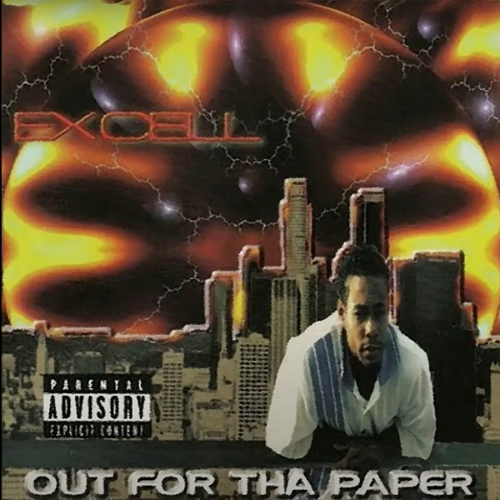
「Bring That Beat Back」は、1998年のExcell作品『Out For Tha Paper』に収録された楽曲。
タイトル通り、この曲で重要なのは何よりも**“Beat”**。
フックでは、
“Bring that beat back, yo”
というフレーズを何度も繰り返し、ラップがビートを支配するというより、ラッパー自身がビートを気に入り、DJに「もう一度戻せ」と要求しているような構造になっている。
そのため曲そのものが、ビートへの賛歌のようにも聞こえる。
第一印象
まず耳を奪うのが、イントロから現れる**「ワウッ」と沈み込むようなシンセ音**。
この音が一定間隔で何度も差し込まれ、曲全体のキャラクターを決定している。
そこへ乾いたドラムが入り、Excellがほとんど間を置かずラップを開始。
爽快な西海岸サウンドというより、
暗い。太い。少し不穏。そして妙にファンキー。
特に面白いのは、トラック自体はかなりシンプルなのに薄く感じないこと。
音数ではなく、ひとつひとつの音の存在感で押してくる。
サウンド分析
ドラム
音源からテンポを解析すると、約99BPM。
ミッドテンポながら、体感的にはかなり前へ進む。
キックは低く太く、スネアは乾いた硬さを持っている。
細かなドラム・フィルで展開を作るタイプではなく、
キック → スネア → キック → スネア
という基本的なヒップホップの骨格を強く感じさせる作り。
この単純さがExcellの細かな言葉数と非常に相性がいい。
ラップが忙しくなってもドラムは動きすぎないため、曲の重心が崩れない。
ベース
低域は派手なベースラインがメロディを奏でるというより、ドラムの下を太く補強する役割が強い。
典型的なG-Funkで聴かれる、滑らかに動き回るベースとは少し違う。
低域を一定の位置に留めることで、上に乗る奇妙なシンセとラップを目立たせている。
結果としてグルーヴは軽快というより、
ズシッ、ズシッと地面を踏みながら進む感覚。
ここがこの曲のストリート感につながっている。
シンセ・メロディ
「Bring That Beat Back」を特徴づけている最大の音が、このシンセ。
冒頭から、
“ワウッ……”
と下降するような、フィルターのかかった電子音が繰り返される。
典型的な高音のG-Funkシンセとは異なり、かなり低く、濁った質感。
しかも旋律らしい旋律をほとんど作らない。
短い音型を何度も戻すことで、催眠的な感覚を作っている。
だからこそタイトルの**「Bring That Beat Back」**とも非常に相性がいい。
曲そのものが「戻る」「繰り返す」という感覚で設計されているように聞こえる。
ミックス・グルーヴ
ミックスも1990年代後半のローカル・ウェストコーストらしい乾いた質感。
ボーカルはかなり前。
その後ろにドラム、低域、特徴的なシンセが配置されている。
空間を大きく広げるリバーブや豪華なレイヤーで包むのではなく、MCとビートを近距離でぶつけるミックス。
約99BPMというテンポも絶妙で、首を振れるファンク感を残しながら、Excellが大量の言葉を詰め込める余裕がある。
ラップ/ボーカル分析
Excellのラップは、この曲のもう一つの主役。
声質は太すぎず、むしろ少し乾いていて鋭い。
そして最大の特徴は言葉をかなり細かく詰め込むフロウ。
ビートがシンプルだからこそ、その上でExcellは細かな韻や言葉遊びを連続させる。
一方、フックになると一気に単純化。
“Bring that beat back, yo”
を何度も反復する。
ヴァースでは言葉数を増やし、フックでは極端に減らす。
この落差によってフックが非常に覚えやすくなっている。
さらに、
“Yo selecta”
というDJ/サウンドシステム的な呼びかけが入ることで、本当にDJへ「今のビートをもう一回」と要求しているようなライブ感も生まれている。
歌詞・テーマ
中心にあるのは、Excell自身のMCとしての自己主張。
自分のラップ・スキル、ストリートでの立場、金、レコード契約、敵対するMCへの挑発などが次々と語られる。
興味深いのは、かなりローカルな視点と広い野心が同居していること。
歌詞ではSouthern Californiaを明示し、さらにInland Empireへの帰属意識も打ち出す。
つまり、
「自分はここから来た」
という地域性を隠していない。
その一方で、レコード・ストアや世界規模での流通にも言及しており、ローカルMCのままで終わるつもりはないという野心も感じられる。
タイトルの「Bring That Beat Back」も単なるフックではない。
ヴァースで自分の実力を見せつけたあと、
「今のビートを戻せ。まだ俺は終わっていない」
と言わんばかりに再びグルーヴへ戻る。
曲全体がExcellのMCとしての自信を示すショーケースになっている。
トリビア
歌詞の中でExcell自身がSouthern Californiaや**I.E.(Inland Empire)**を明確に意識している点は、この曲を理解するうえで重要。
単なる「西海岸ラップ」という括りよりも、Riversideを含むInland Empire側から発せられたローカル・ウェストコーストとして聴くと、この曲の位置づけがより鮮明になる。
また、フックで繰り返される「Bring that beat back」は、通常の歌唱フックというよりDJへの掛け声そのものをコーラス化したような構造。
そのため非常に単純ながら、曲のコンセプトとビートが完全に一致している。
制作メモ
この曲で特に優れているのは、音を増やさずに個性を作っていること。
特徴的なシンセ。
太いドラム。
低域。
そしてExcellのラップ。
基本的にはこれらを中心に最後まで進んでいく。
しかし退屈にならない。
その理由は、トラック側が大きく展開するのではなく、Excellのフロウとフックの反復によって曲のテンションを変化させているからだ。
特にフックに入って、
“Bring that beat back, yo”
が連打される瞬間。
ここでは新しいメロディを追加する必要すらない。
「このビートをもう一度聴かせろ」という言葉そのものが、次のビートを気持ちよく感じさせる仕掛けになっている。
非常にヒップホップ的な発想の一曲だ。
総評
Excell「Bring That Beat Back」は、派手なG-Funkを期待すると少し違って聞こえる。
しかし、そこが面白い。
約99BPMの太いドラム、低くうねるワウ/フィルター系シンセ、必要最低限の低域、そして細かく言葉を刻むExcell。
1990年代後半の南カリフォルニアらしいファンク感を残しながら、より硬く、より地下へ潜ったサウンドになっている。
そして何より、
「Bring that beat back」
という単純な一言を曲そのものの構造にしてしまったところが強い。
メロディで魅了するのではない。
豪華なコーラスで包むのでもない。
ただビートを鳴らし、ラップし、もう一度そのビートを戻す。
ビートが良ければ、それだけで首は動く。
そんなヒップホップの根本的な快感を、Riverside/Inland Empireの乾いた空気の中で鳴らした一曲だ。
Excell – Bring That Beat Back | Raw Inland Empire Funk Built Around the Beat
“Bring that beat back, yo…”
Once that phrase gets inside your head, it is difficult to escape the repetition of the words and the beat underneath them.
Excell’s “Bring That Beat Back” is not the kind of West Coast rap built around lush melodies or smooth R&B vocals.
Instead, the foundation is brutally simple:
heavy drums at approximately 99 BPM, a low wah/filter-like synth twisting underneath, and Excell constantly pushing his flow forward.
The production refuses to add more sounds than necessary.
It finds one powerful groove and rides it from beginning to end.
Coming out of Southern California in the late 1990s, “Bring That Beat Back” captures a dry, underground street atmosphere almost entirely through the strength of its beat.
Artist Introduction
Excell is a rapper associated with the local rap scene around Riverside, California—part of Southern California’s Inland Empire.
That regional identity is strongly present in “Bring That Beat Back.”
The lyrics explicitly reference:
“Southern California”
and:
“I own the I.E.”
Rather than coming from one of the massive West Coast rap centers such as Los Angeles or Long Beach, Excell presents himself as a local MC determined to make his own area heard.
That attitude is one of the defining qualities of the track.
This is not simply West Coast rap.
It carries the identity of the Inland Empire with it.
Background
“Bring That Beat Back” appears on Excell’s 1998 release Out For Tha Paper.
As the title suggests, the most important element of the song is exactly what it says:
the beat.
Throughout the hook, Excell repeatedly calls:
“Bring that beat back, yo.”
The effect is unusual.
Rather than sounding like a rapper completely dominating the instrumental, Excell almost sounds impressed by the beat himself—like an MC turning toward the DJ and demanding that the groove be brought back one more time.
Because of that, the entire track begins to feel like a celebration of the beat itself.
The instrumental is not merely underneath the song.
The instrumental is part of the song’s subject.
First Impression
The first sound that immediately defines the track is the strange synth that appears from the intro.
It drops downward with a filtered:
“Wahh…”
That sound repeatedly returns at regular intervals until it becomes part of the track’s identity.
Then the dry drums arrive.
Excell begins rapping almost immediately.
This is not the bright, sunny side of West Coast funk.
It feels:
dark.
thick.
slightly threatening.
and strangely funky.
What makes the production especially interesting is how full it sounds despite being relatively minimal.
There are not many elements competing for attention.
Instead, each sound has enough weight to make its presence felt.
The track does not overwhelm through quantity.
It overwhelms through impact.
Sound Analysis
Drums
The recording sits at approximately 99 BPM.
That puts it in a midtempo range, but the track still feels as though it is constantly pushing forward.
The kick is low and thick.
The snare has a dry, hard attack.
Rather than relying on complicated fills or constantly changing percussion patterns, the rhythm emphasizes the fundamental skeleton of hip-hop:
kick → snare → kick → snare.
That simplicity works extremely well with Excell’s dense delivery.
His flow can become busy without destabilizing the track because the drums refuse to become busy with him.
The rapper moves.
The drums remain planted.
That relationship gives “Bring That Beat Back” much of its physical weight.
Bass
The low end is less about playing a memorable melodic bassline and more about reinforcing the drums from underneath.
This is slightly different from the smoother, more mobile basslines often associated with classic G-Funk.
The bass remains relatively anchored.
By keeping the low frequencies in one controlled area, the production leaves more space for the unusual synth texture and Excell’s vocals.
The result is not a light, bouncing groove.
It feels more like:
step.
step.
step.
Heavy movement across the ground.
That physical sensation contributes directly to the track’s street-level atmosphere.
Synths & Melody
The most distinctive musical sound in “Bring That Beat Back” is the synth.
From the opening, a filtered electronic tone repeatedly drops downward:
“Wahh…”
Unlike the bright, high-register lead synth commonly associated with G-Funk, this sound sits lower and has a murkier texture.
More importantly, it barely functions as a conventional melody.
Instead, the production repeats a short figure over and over.
That creates a hypnotic effect.
And it perfectly matches the title:
“Bring That Beat Back.”
Everything in the track seems designed around the idea of returning.
Repeating.
Coming back to the same groove.
The hook asks for the beat again.
The synth returns again.
The drums return again.
The repetition becomes the concept.
Mix & Groove
The mix carries the dry character associated with underground late-1990s West Coast rap.
Excell’s vocal sits far forward.
Behind him are the drums, low end, and distinctive filtered synth.
There is no attempt to surround everything with huge reverbs or luxurious layers.
Instead, the mix places the MC and beat in close physical contact.
At approximately 99 BPM, the tempo also hits an effective middle ground.
There is enough funk to keep the head moving, but still enough space for Excell to pack large amounts of language into each verse.
The beat remains simple.
The rapper supplies the complexity.
Rap / Vocal Analysis
Excell’s performance is the other major force driving the record.
His voice is not extremely deep.
It has a slightly dry, sharp quality that cuts cleanly through the instrumental.
But the defining characteristic is his dense flow.
He packs words tightly into the open spaces of the beat, stacking rhymes and wordplay over an instrumental that deliberately refuses to become complicated.
Then the hook arrives and everything changes.
The lyrical density suddenly disappears.
Instead, Excell repeats:
“Bring that beat back, yo.”
Again.
And again.
The verses increase the number of words.
The hook strips them away.
That contrast makes the chorus extremely easy to remember.
The appearance of:
“Yo selecta”
adds another dimension.
It carries the feeling of a direct call toward a DJ or sound-system selector.
For a moment, the record feels less like a studio recording and more like an MC turning around in the middle of a performance and demanding:
Run that beat again.
That small detail gives the hook genuine live energy.
Lyrics & Themes
At the center of the lyrics is Excell’s confidence in himself as an MC.
He moves through claims about his rap ability, street position, money, record deals, and rival MCs.
What makes the perspective interesting is the combination of intense local identity and much larger ambition.
Excell explicitly represents Southern California.
More specifically, he identifies with the Inland Empire.
The message is clear:
“This is where I come from.”
He does not attempt to hide his regional identity or make himself sound as though he belongs to Los Angeles.
But at the same time, the lyrics reach beyond the local scene.
References to record stores, distribution, and a wider audience suggest an MC who does not intend to remain known only in his immediate area.
That tension gives the song another layer.
He is local.
But his ambition is not.
The title phrase also becomes more than a simple chorus.
After using the verses to demonstrate his ability, Excell returns to the hook almost as if he is saying:
Bring that beat back. I’m not finished yet.
The entire song therefore functions as a showcase of his confidence as a rapper.
Trivia
Excell’s explicit references to Southern California and the **I.E.—Inland Empire—**are important to understanding the track.
Rather than treating “Bring That Beat Back” simply as generic West Coast rap, it makes more sense to hear it as a local Southern California record emerging from the Inland Empire, including the Riverside area.
That regional perspective gives the song a clearer identity.
The repeated “Bring that beat back” hook is also unusual in its simplicity.
It does not function like a conventional sung chorus.
Instead, it feels almost like a DJ command transformed into the central hook of the song.
That is why such a basic phrase works so effectively.
The title, hook, and production concept all point toward the same thing:
the beat.
Production Notes
One of the strongest qualities of “Bring That Beat Back” is how much personality it creates with so few elements.
The strange synth.
Heavy drums.
Low frequencies.
Excell’s voice.
Those basic components carry almost the entire record.
And yet the track does not become boring.
The reason is that the instrumental does not need to create dramatic changes.
Excell’s flow and the repeated hook create the changes instead.
That becomes especially clear when the chorus arrives.
“Bring that beat back, yo.”
No new melody is necessary.
No huge instrumental layer needs to appear.
The phrase itself changes the way the listener experiences the next repetition of the beat.
He tells you to want the beat again—
and then the beat returns.
It is a simple idea, but a deeply hip-hop one.
Final Thoughts
Excell’s “Bring That Beat Back” may sound unusual if you approach it expecting flashy G-Funk.
But that is exactly what makes it interesting.
Heavy drums at approximately 99 BPM.
A low, murky wah/filter-style synth.
Minimal low-end reinforcement.
And Excell cutting through it with a dense, tightly packed flow.
The track retains the funk of late-1990s Southern California rap while pushing it into something harder, drier, and more underground.
Above everything else, its greatest strength is the way one simple phrase becomes the structure of the entire record:
“Bring that beat back.”
The song does not need to seduce the listener with melody.
It does not need a luxurious sung chorus.
It plays the beat.
Excell raps.
Then he demands that the beat come back.
And it does.
When the beat is strong enough, sometimes that is all hip-hop needs to make your head move.
“Bring That Beat Back” captures that fundamental pleasure in the dry, underground atmosphere of Riverside and the Inland Empire.
コメント