「Okay, everybody, lie down on the floor and keep calm.」
強盗現場を思わせる声から始まり、叫び声の直後に滑り込んでくる重いビート。
Kage「Um That Nigga」は、1994年のJackson, Mississippi産Southern Gangsta Rap/G-Funk。実際の音源を解析すると、体感テンポは約81BPM。ゆっくりと車を流すような速度の上で、太いベース、乾いたドラム、薄暗いシンセ/鍵盤系の音色が絡み合う。
華やかな西海岸G-Funkとは少し違う。
ここにあるのは、南部の湿気とローカル・ストリートの荒さをまとったG-Funkだ。
アーティスト紹介
Kageは、Jackson, Mississippiを拠点としたGangsta Rapアーティスト。
「Um That Nigga」はキャリア初期にあたる1994年の楽曲で、この時点ですでにKageの名前を「K-A-G-E」と一文字ずつ刻み込むセルフ・ブランディングが強く打ち出されている。
ラップそのものも技巧を前面に押し出すタイプではなく、低い声と落ち着いたフロウで自分の存在感を押し出していくスタイルだ。
作品背景
「Um That Nigga」は、1994年のカセット作品**『Just Another Day Just Another Dollar』**に収録された初期Kageの楽曲。
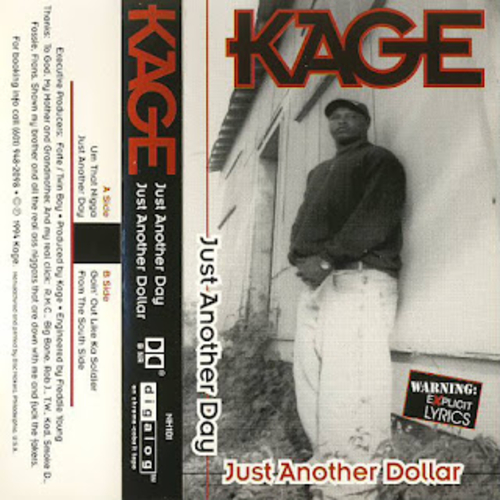
今回の音源は約3分42秒。
歌詞には「South Side」「my hood」といった地元を意識させる言葉が登場し、車、金、マリファナ、仲間、敵対者、銃といった90年代Gangsta Rapのモチーフが次々と現れる。
ただし単なる威嚇だけではない。
Kageは自分自身を、
“that nigga that you love to hate”
――「お前らが嫌いながらも気になって仕方ない男」として演出している。
この悪役的な自己演出こそ、この曲の核になっている。
第一印象
最初に感じるのは、遅い。太い。そして妙な心地よさ。
約81BPMのビートには急ぐ感覚がなく、Kageもビートを追いかけない。
むしろ一歩後ろから、
ズルッ、ズルッと引きずるようにラップを乗せる。
この遅さが、歌詞に登場する「rolling real slow」「high ride」「Monte Carlo」といった車の描写と見事に重なる。
深夜のJacksonを窓を開けてゆっくり流しているような感覚。
ただしリラックスしているわけではない。
常にどこか危険な気配が漂っている。
サウンド分析
ドラム
ドラムは非常にシンプル。
キックは低く重く、スネアは乾いている。
細かなフィルや派手なブレイクを入れるのではなく、
「ドン――パン――ドン――パン」
という骨格をほぼ崩さない。
この単調さが逆に重要で、約81BPMの遅いグルーヴをさらに重たく感じさせる。
ヒップホップ的な首振りというより、車体そのものが上下するようなバウンスだ。
ベース
この曲で最も耳を引くのがベース。
丸く太い低音がトラックの底を這い続ける。
Kage自身が、
“with the bumps of the G-Funk / seepin’ out my … trunk”
とラップしているように、完全に車のトランクから鳴らすことを想定したような低域設計になっている。
ただ低音を鳴らすだけではなく、音程を動かしながら小さくうねる。
このベースがあることで、トラックにはGangsta Rapの荒さと同時にファンク特有の色気が生まれている。
シンセ・メロディ
上物はかなり控えめ。
派手な高音シンセを前面に出すタイプのG-Funkではなく、薄い鍵盤/シンセ系のフレーズが背景を漂う。
そのため主役はあくまで、
ベース+ドラム+Kageの声。
空間を埋めすぎないことで、音と音の間に独特の暗さが生まれている。
ここがCalifornia系G-Funkとは少し違うところ。
陽光や海岸線というより、夜の住宅街、街灯、信号待ちの車を連想させる音だ。
ミックス・グルーヴ
ミックスも1994年のローカルGangsta Rapらしい粗さを残している。
現代的な低域の分離感ではなく、ベース、キック、声が少し密着している。
しかし、その粗さがむしろ曲の魅力。
テンポ解析では倍取りで約161BPM付近も検出されるが、実際の聴感はその半分の約81BPMとして捉えるのが自然だ。
このハーフタイム感によって、
“slow rolling”
という言葉がそのまま音になっている。
ラップ/ボーカル分析
Kageのラップは低く、太く、ほとんど慌てない。
細かな韻を高速で畳みかけるタイプではなく、単語をビートの隙間へ置いていく。
特に、
K-A-G-E
と自分の名前を一文字ずつ発音する部分が強烈。
フックでは、
“I’m that nigga that you love to hate”
“Who are you nigga?”
“The K-A-G-E”
というコール&レスポンスを繰り返す。
これが非常にキャッチー。
メロディアスなサビというより、名前を観客に覚えさせるためのチャントに近い。
4回繰り返されることで、初めて聴いた人間にも「K-A-G-E」が残る仕組みになっている。
歌詞・テーマ
歌詞の中心にあるのはKage自身だ。
冒頭から、
「just another taste of the K-A-G-E」
と自分を提示する。
そこから車で街を流し、South Sideへ向かい、女性、金、仲間、敵について語っていく。
特に車の描写が多い。
「high ride」「Cadillac」「white Monte Carlo」「stoplight」「six-four」「trunk」など、車が単なる移動手段ではなく、Kageという人物を表現する舞台として機能している。
そして興味深いのが過去について触れる2ヴァース目。
Kageは自分を、かつては手に負えない少年だったと振り返り、昔のCadillacから現在の白いMonte Carloへと話をつなげる。
つまりこれは単純な自慢話だけではなく、
「昔から俺はこういう人間だった」
という自己神話の構築でもある。
3ヴァース目になると空気はさらに危険になる。
敵対者、銃、仲間、自分を狙う者たちについて語りながら、それでもKageは街をゆっくり流し続ける。
この曲で重要なのは「恐怖」よりも余裕だ。
危険な世界を語っているのに、本人は焦らない。
その態度と約81BPMのビートが完全に一致している。
トリビア
曲の冒頭と最後には、
“Okay, everybody, lie down on the floor and keep calm.”
という声が入る。
その直後に叫び声が入り、ビートへ突入する構成だ。
さらにアウトロでも同じ声が戻ってくるため、曲全体がこの音声によって挟み込まれている。
また歌詞の中でKage自身が明確に**“G-Funk”**と言及している点も面白い。
音だけを聴いてG-Funkと推測するのではなく、本人が楽曲内でその言葉を使用している。
制作メモ
音源から確認できる最大の特徴は、G-Funkの構造をJackson, MississippiのローカルGangsta Rapへ落とし込んでいること。
約81BPMのテンポ、太いベース、乾いたドラム、空間を残した上物、低いラップ。
どれも派手ではない。
しかし音数を絞っているからこそKageの声が前へ出る。
さらにフックでは複雑なメロディを作らず、
「Who are you?」→「K-A-G-E」
という極端に単純な構造を採用。
その結果、アンダーグラウンド作品ながらサビだけは一度で覚えられる。
総評
Kage「Um That Nigga」は、1994年Jackson, Mississippiの空気を閉じ込めたSouthern Gangsta Rap/G-Funkだ。
約81BPM。
太くうねるベース。
乾いたドラム。
薄暗い上物。
そして低い声で「K-A-G-E」と名乗り続けるKage。
西海岸G-Funkの華やかさを期待すると少し違う。
ここにあるのはもっとローカルで、もっと粗く、もっと湿っている。
特に印象的なのは、歌詞とビートの一致だ。
Kageは何度も車で「slow」に街を流す情景を描く。そしてトラック自体も、本当にゆっくり街を這うように進んでいく。
深夜のJackson。白いMonte Carlo。トランクから漏れるG-Funk。
その風景まで見えてくるような一曲。
90年代G-FunkをCaliforniaだけで追っていると、こういう曲にはなかなか辿り着かない。
だからこそ「Um That Nigga」は面白い。
G-Funkが南部のローカル・シーンへ入り込み、別の湿度を帯びた瞬間を聴けるような、Jackson産アンダーグラウンドの隠れた一曲だ。
Kage – Um That Nigga | Slow-Rolling Mississippi G-Funk from the Streets of Jackson
A voice that sounds like the beginning of a robbery.
A scream.
Then the heavy beat slides in.
Kage’s “Um That Nigga” is 1994 Southern Gangsta Rap / G-Funk from Jackson, Mississippi.
Analysis of the recording puts its natural feel at approximately 81 BPM.
At that slow cruising speed, thick bass, dry drums, and shadowy synth and keyboard textures move underneath Kage’s low voice.
This is not quite the bright, polished G-Funk associated with California.
What you hear instead is:
G-Funk covered in Southern humidity and the rawness of a local Mississippi street record.
Artist Introduction
Kage was a Gangsta Rap artist based in Jackson, Mississippi.
“Um That Nigga” comes from the early part of his career in 1994, and even at this stage he was already strongly establishing his identity by spelling out his name:
K-A-G-E.
His rap style is not primarily about technical exhibition.
Instead, Kage relies on a low voice, controlled pacing, and an unhurried flow to establish his presence.
He does not need to chase the beat.
He lets the beat move underneath him.
That calm delivery becomes one of the defining characteristics of “Um That Nigga.”
Background
“Um That Nigga” appears on Kage’s 1994 cassette release Just Another Day Just Another Dollar.
The recording runs for approximately 3:42.
The lyrics contain local and street-oriented references such as “South Side” and “my hood,” alongside familiar 1990s Gangsta Rap imagery involving cars, money, marijuana, friends, enemies, and guns.
But the track is not simply built around threats.
Kage presents himself as:
“that nigga that you love to hate.”
That idea is essential.
He deliberately constructs himself as the villain—the man people may dislike but cannot ignore.
That antihero persona becomes one of the central ideas behind the record.
First Impression
The immediate feeling is:
slow, heavy, and strangely comfortable.
At approximately 81 BPM, the beat never seems to be in a hurry.
Neither is Kage.
Rather than chasing the rhythm, his flow seems to drag slightly behind it.
Almost like every line is sliding across the pavement.
That slow movement fits perfectly with the automotive imagery in the lyrics:
“rolling real slow,”
the high ride,
the Monte Carlo.
It feels like driving through Jackson late at night with the windows down.
But the atmosphere is never completely relaxed.
Something dangerous always seems to be waiting nearby.
That combination—comfort and threat—is one of the track’s greatest strengths.
Sound Analysis
Drums
The drums are extremely simple.
The kick is low and heavy.
The snare is dry.
Instead of relying on elaborate fills or dramatic breaks, the beat largely preserves the same basic skeleton:
boom — clap — boom — clap.
That repetition is important.
At approximately 81 BPM, every drum hit is given enough room to feel heavier.
This is less like conventional hip-hop head-nodding and more like the entire body of a car bouncing up and down.
The beat does not need to move quickly.
Its weight creates the movement.
Bass
The bass is one of the first elements that really grabs the ear.
A thick, rounded low end crawls underneath the entire track.
Kage himself refers to:
“the bumps of the G-Funk”
coming from the trunk.
That description fits the production remarkably well.
The low end sounds designed for music coming out of a car trunk.
But the bass does more than simply produce weight.
It shifts in pitch and moves subtly through the groove.
That movement adds a certain sensual funkiness underneath the harder Gangsta Rap atmosphere.
The bass makes the track threatening.
But it also makes it feel good.
Synths & Melody
The upper instrumental layers remain restrained.
This is not G-Funk dominated by a huge, high-pitched lead synth.
Instead, faint keyboard and synth textures drift through the background.
That leaves the center of the record to three main elements:
bass + drums + Kage’s voice.
By refusing to fill every available space, the production creates darkness between the sounds.
That is one of the major differences between this track and more polished California G-Funk.
The imagery is not sunshine and coastline.
It feels closer to:
residential streets at night,
streetlights,
and a car waiting at a red light.
The emptiness is part of the atmosphere.
Mix & Groove
The mix retains the roughness of a local 1994 Gangsta Rap recording.
The bass, kick, and vocals are not separated with modern precision.
They sit relatively close together.
But that roughness works in the track’s favor.
Tempo analysis can also detect the rhythm at around 161 BPM when counted in double time.
In practical listening terms, however, the natural pulse is much closer to half of that:
approximately 81 BPM.
That halftime feel is crucial.
It turns the idea of:
“slow rolling”
into something you can actually hear in the rhythm.
The lyrics describe slow movement through the streets.
The production moves exactly the same way.
Rap / Vocal Analysis
Kage’s delivery is low, thick, and almost completely unhurried.
He is not the kind of rapper who tries to overwhelm the listener with rapid-fire rhyme patterns.
Instead, he places individual words into the open spaces of the beat.
One of the strongest moments comes when he spells his name:
K-A-G-E.
The hook uses a call-and-response structure built around:
“I’m that nigga that you love to hate.”
“Who are you nigga?”
“The K-A-G-E.”
It is extremely effective.
Rather than functioning as a melodic chorus, it sounds almost like a chant designed to force the audience to remember his name.
By repeating the pattern several times, Kage makes sure that even a first-time listener leaves the track knowing exactly who he is.
K-A-G-E.
The hook is branding turned into rhythm.
Lyrics & Themes
The central subject of “Um That Nigga” is Kage himself.
Early in the track, he introduces the listener to:
“just another taste of the K-A-G-E.”
From there, he cruises through the streets, heads toward the South Side, and talks about women, money, friends, enemies, and his surroundings.
Cars appear constantly.
The lyrics reference images including a high ride, Cadillac, white Monte Carlo, stoplights, a six-four, and music coming from the trunk.
The car is not simply transportation.
It becomes a stage on which Kage performs his identity.
That becomes even more interesting when the second verse turns toward his past.
Kage reflects on being difficult to control when he was younger, connecting the cars and attitude of his past with the white Monte Carlo of his present.
The message is essentially:
I have always been this person.
In that sense, the track does more than brag.
It builds a personal mythology around Kage.
By the third verse, the atmosphere becomes more dangerous.
Enemies.
Guns.
Friends.
People who may be coming after him.
Yet even as the subject matter becomes more threatening, Kage continues moving through the city at the same slow pace.
That is the important point.
The dominant emotion is not fear.
It is composure.
The world around him may be dangerous.
Kage refuses to sound nervous.
And the approximately 81 BPM beat behaves exactly the same way.
Trivia
The track opens and closes with the voice:
“Okay, everybody, lie down on the floor and keep calm.”
A scream follows near the beginning before the beat enters.
The same voice returns during the outro, effectively framing the entire song with what sounds like a robbery scene.
Another particularly interesting detail is Kage’s explicit use of the term “G-Funk” in the lyrics.
That matters because the classification is not based only on listeners hearing certain bass or synth characteristics and applying the label afterward.
Kage himself invokes G-Funk inside the record.
For a 1994 underground rap recording from Jackson, Mississippi, that detail makes the track especially interesting within the wider regional spread of the sound.
Production Notes
The most distinctive feature of the recording is the way it brings G-Funk structure into local Jackson, Mississippi Gangsta Rap.
The ingredients are simple:
approximately 81 BPM,
thick bass,
dry drums,
minimal atmospheric instrumentation,
and low-register rapping.
Nothing is especially flashy.
But because the production leaves so much space, Kage’s voice becomes more powerful.
The hook applies the same principle.
There is no complicated melody.
Instead, it uses an extremely simple exchange:
“Who are you?”
followed by:
“K-A-G-E.”
That simplicity makes the chorus instantly memorable despite the underground nature of the recording.
The beat does not need to prove anything.
Neither does Kage.
Both simply move slowly and confidently.
Final Thoughts
Kage’s “Um That Nigga” captures the atmosphere of 1994 Jackson, Mississippi Southern Gangsta Rap / G-Funk.
Approximately 81 BPM.
Thick, crawling bass.
Dry drums.
Shadowy instrumentation.
And Kage repeatedly announcing himself in a low voice:
K-A-G-E.
If you approach the track expecting the glossy side of West Coast G-Funk, it may sound very different.
This is more local.
Rougher.
Darker.
And somehow more humid.
What makes the record especially effective is the connection between the lyrics and the production.
Kage repeatedly describes moving slowly through the streets.
And the beat itself really does feel like it is crawling through the city.
Jackson after midnight.
A white Monte Carlo.
G-Funk leaking from the trunk.
The production is strong enough to make that scene visible.
If your understanding of 1990s G-Funk begins and ends in California, records like this are easy to miss.
And that is exactly why “Um That Nigga” is so interesting.
It sounds like G-Funk traveling south, entering a local Mississippi scene, and coming out with an entirely different kind of humidity—a hidden piece of Jackson underground rap built for slow rolling after dark.
コメント